
If you are navigating high-performance skincare in your late twenties or early thirties, chances are you have experienced the brutal “retinol purge.” We are constantly told that Vitamin A derivatives are non-negotiable for smoothing fine lines, accelerating cellular turnover, and keeping our skin firm. But for many with reactive skin or a delicate moisture barrier, traditional retinoids are a quick path to irritation. They leave skin peeling, uncomfortably tight, perpetually flushed, and hypersensitive to even the gentlest hydrating creams.
I remember hitting a painful wall in my own nighttime routine when I tried to force a prescription-strength retinoid to work. Every evening felt like a gamble. My T-zone was dry, my cheeks were visibly inflamed, and applying foundation the next morning felt like painting over dry plaster. Stopping the retinoid meant losing out on collagen support, but continuing it actively ruined my moisture barrier. The issue was not that my skin did not need nighttime cellular regeneration—it was that standard Vitamin A forced cellular turnover at the expense of my stratum corneum’s lipid integrity.
Everything changed when I stopped treating cellular renewal and barrier restoration as separate steps. True overnight recovery requires an active ingredient that activates retinoic pathways without inducing neurogenic heat, paired directly with lipids that stitch the stratum corneum back together. This is precisely why combining Phyto-Retinol and Ceramide Complex has emerged as the most advanced, clinically backed protocol for achieving smooth, resilient skin overnight without triggering barrier breakdown.
1. The Molecular Science of Phyto-Retinol and Ceramide Complex
To understand why integrating Phyto-Retinol and Ceramide Complex yields far better nighttime results than traditional retinoids, we must examine how these active molecules function together within skin tissue.
Phyto-retinol—most notably high-purity Bakuchiol derived from Psoralea corylifolia—is a natural meroterpene. While structurally distinct from Vitamin A, gene-expression profiling reveals that it regulates many of the exact same retinoic acid receptor genes, stimulating Type I, III, and IV collagen synthesis.
When applied topically during your evening routine, this bio-mimetic duo operates through three distinct biological pathways:
Pathway-Specific Cellular Renewal Without Receptor Shock
Unlike direct retinoic acid, which binds aggressively to retinoic acid receptors and causes rapid scaling and barrier dysfunction, phyto-retinol gently upregulates extracellular matrix components (such as fibronectin and collagen). It accelerates epidermal regeneration without triggering severe inflammatory cytokines or trans-epidermal water loss, eliminating the dreaded purging phase.
Lipid Matrix Integration via Ceramide NP, AP, and EOP
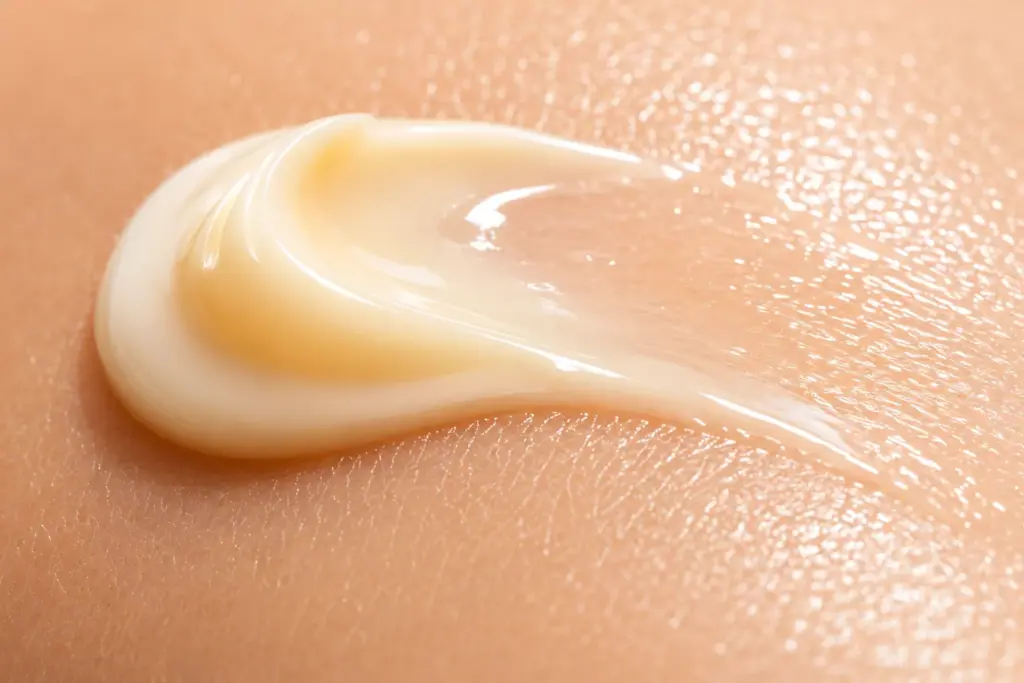
While phyto-retinol signals fibroblasts to produce fresh collagen, a biomimetic Ceramide Complex replenishes the essential intercellular lipids that hold keratinocytes together. This complex supplies ceramides, cholesterol, and free fatty acids in a natural 3:1:1 ratio, filling microscopic gaps in damaged skin and preventing overnight moisture evaporation.
Synergistic Antioxidant and Barrier Reinforcement
Phyto-retinol possesses potent intrinsic antioxidant properties that inhibit lipid peroxidation. When paired with ceramides, it actively protects freshly renewed skin cells from oxidative stress while you sleep, ensuring that newly formed collagen fibers remain stable, resilient, and non-photosensitizing.
2. Clinical Evidence on Meroterpenes and Lipid Matrix Restoration
The therapeutic benefits of plant-derived retinol alternatives paired with barrier-replenishing lipids are extensively documented in modern dermatology. Clinical research confirms that functional phyto-retinols reduce fine lines and hyperpigmentation with significantly better skin tolerance than conventional retinoids.
According to recent clinical investigations evaluating the cellular mechanisms of facial aging, bakuchiol-based phyto-retinols significantly increase extracellular matrix protein expression, augment epidermal regeneration, and decrease inflammatory markers. Research demonstrates that topical application accelerates wound healing and improves skin firmness without inducing the stinging, scaling, or dryness typical of standard Vitamin A derivatives.
To integrate this restorative night protocol into your routine for maximum collagen synthesis and barrier protection, follow this structured application method:
Step 1: Gentle Cleansing and Hydration Prep
Begin your nighttime routine with a non-foaming, pH-balanced cleanser to remove urban pollutants and sunscreen without stripping essential lipids. Pat skin dry. If your skin needs an extra layer of daytime defense, explore our morning protocol on THD Ascorbate and Ferulic Acid to learn how oil-soluble antioxidants shield skin against environmental oxidative stress before your night recovery begins.
Step 2: Applying the Phyto-Retinol Base
Dispense 2–3 drops of your Phyto-Retinol serum onto clean hands and press it gently into the skin. Because phyto-retinols are photostable and non-irritating, they do not require a slow tapering period and can be comfortably used every evening without triggering purging or sensitivity.
Step 3: Locking In with Ceramide Complex
Follow immediately with a barrier-repair cream enriched with a Ceramide Complex. This locks in the active plant meroterpenes, seals micro-fissures in the stratum corneum, and creates a protective cocoon that allows deep cellular regeneration throughout your sleep cycle.
3. Comparative Breakdown: Traditional Retinol vs. Phyto-Retinol Protocol
To clarify how this botanical regeneration system compares to conventional Vitamin A treatments, review this straightforward breakdown of their clinical performance:
| Metric / Feature | Traditional Retinol (0.5%–1.0%) | Granactive Retinoid (HPR) | Phyto-Retinol Protocol (Phyto-Retinol and Ceramide Complex) |
| Primary Active Mechanism | Converts to Retinoic Acid | Directly binds retinoic receptors | Regulates retinoic genes via plant meroterpenes |
| Barrier Impact | High risk of scaling & peeling | Moderate risk of dryness | Zero damage; actively reinforces lipid matrix |
| Purging Phase | Common (2–6 weeks) | Mild to rare | None / Immediate comfort & zero purging |
| Photosensitivity | High (Requires strict night use) | Moderate | Non-photosensitizing; highly stable |
| Skin Compatibility | Resilient skin only | Normal to combination skin | Sensitive, reactive, or compromised barriers |
| Primary Target Outcome | Rapid turnover with peeling risk | Moderate line smoothing | Deep collagen support, smooth texture, & plump barrier |
4. Advanced Application Rules and Compatibility
Seamless Nighttime Layering
One of the greatest benefits of Phyto-Retinol and Ceramide Complex is its exceptional formula compatibility. Unlike traditional retinoids, which destabilize or cause severe irritation when layered with exfoliating acids or Vitamin C, phyto-retinol is non-acidic and chemically stable. You can safely layer it over hydrating hyaluronic acid serums or under rich peptide creams without risking flushing, peeling, or active neutralization.
5. Conclusion: Overnight Recovery Without Compromise
Achieving smooth, plump, and youthfully firm skin does not mean enduring weeks of peeling, redness, and a broken moisture barrier. By embracing the restorative science of Phyto-Retinol and Ceramide Complex, you can stimulate deep dermal collagen synthesis while nourishing your skin’s vital lipid seal. Supporting your skin’s biological repair mechanisms overnight ensures you wake up to a calm, resilient, and glowing complexion every morning.
Medical Disclaimer
The information provided in this article is for educational and informational purposes only and should not be construed as professional medical advice, diagnosis, or treatment. Always seek the advice of your dermatologist or other qualified health provider with any questions you may have regarding a specific skin condition or cosmetic protocol.